Category Archives: Agri-PV

Agri-PV, Press Release

Minister President Kretschmann Visits Blankenhornsberg

14.07.2025

Agri-PV as a Beacon of Hope for Viticulture and Climate Protection

Ihringen, June 26, 2025 – Minister President Winfried Kretschmann visited the State Winery at Blankenhornsberg in Ihringen on Thursday to explore innovative solutions addressing the current challenges in viticulture. A key focus of his visit was the Viti-Photovoltaic system implemented by Intech GmbH & Co. KG from Kehl for research purposes.

Viti-PV Technology: Combining Energy Generation and Wine Quality

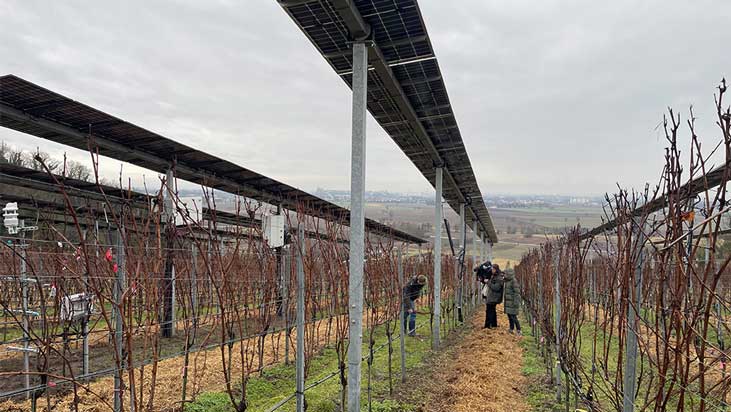
At Blankenhornsberg, two different Viti-PV systems have been installed across a 0.4-hectare vineyard. The 240 kWp installation combines fixed-mounted semi-transparent PV modules with an innovative solar tracking system featuring opaque modules that automatically adjust to the sun’s position. The tracking control system was developed by Intech and is continuously adapted in collaboration with the State Viticulture Institute to meet the specific requirements of viticulture. In addition to electrical parameters, factors such as tilt angle, solar irradiance, plant health, leaf moisture, and soil moisture are monitored and analyzed for optimization.
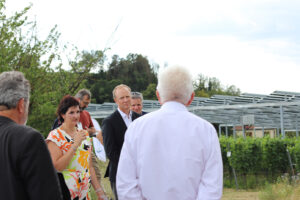
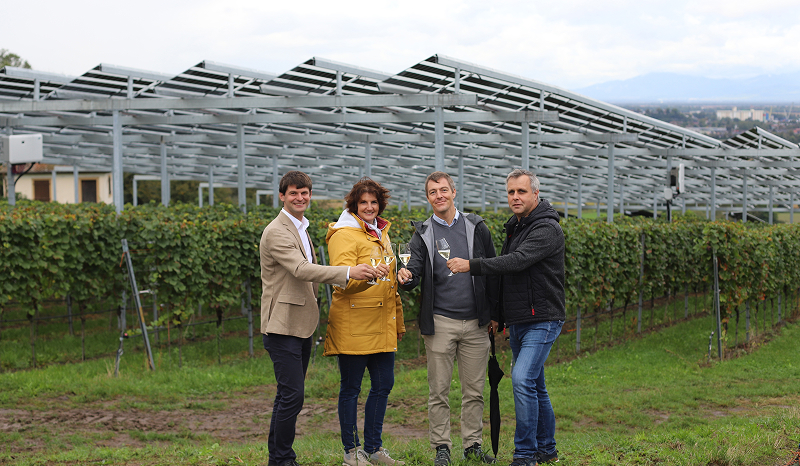
Dr. Bettina Frank-Renz (Director, State Viticulture Institute) and Kolja Bitzenhofer (Director, State Winery) presenting the Viti-PV installation at Blankenhornsberg.

Dr. Bettina Frank-Renz (Director, State Viticulture Institute) and Kolja Bitzenhofer (Director, State Winery) presenting the Viti-PV installation at Blankenhornsberg.

Opportunities and Challenges

The innovative system aims not only to produce electricity but also to enhance the physiological health of grapevines. Initial results are promising: shading from the PV modules delays grape ripening, which can positively affect the acidity levels and thus the quality of the wine. Further research results are currently being evaluated.

However, challenges remain. “Not every agricultural plot has a power connection nearby. Even the 400 meters of connection we needed here were a significant financial investment. The cost of grid connection can therefore be a decisive factor for constructing such systems,” explained Bettina Frank-Renz, Director of the State Viticulture Institute.

Additionally, machinery cannot access all vineyard rows, sometimes requiring manual labor. Integrating the PV system into existing vineyards also presents complexity.

“We have to try new things, examine them scientifically, and determine whether they make sense and can be economically viable for viticulture,” emphasized Minister President Kretschmann during his tour.

A Contribution to Climate Protection

Beyond improving wine quality, the installation also contributes to climate protection. The CO₂ footprint of the steel structure totals 41.19 tons, while the system saves approximately 150 tons of CO₂ annually. The electricity generated is sufficient to supply around 160 households or can be used directly for electrical equipment in the vineyard.

The Viti-PV installation is part of the “Viticulture 4.0” flagship project under the RegioWIN 2030 program, funded by the State of Baden-Württemberg and the European Union. It powerfully demonstrates how dual land use in agriculture can sustainably shape the future of viticulture.
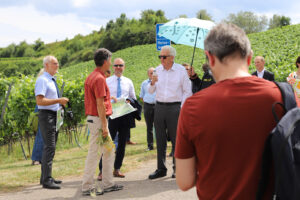
Minister President Winfried Kretschmann in conversation with Reinhold Treiber (Managing Director, Landscape Conservation Association Breisgau-Hochschwarzwald) discussing biodiversity at the Kaiserstuhl.

Minister President Winfried Kretschmann in conversation with Reinhold Treiber (Managing Director, Landscape Conservation Association Breisgau-Hochschwarzwald) discussing biodiversity at the Kaiserstuhl.

Winemakers Engage in Dialogue with Politics

The visit was accompanied by a peaceful protest by local winemakers, who used banners to highlight their challenging economic situation. Climate change, rising production costs, and declining wine consumption are placing significant pressure on many businesses. Kretschmann stressed that preserving cultural landscapes, ensuring the economic viability of farms, and embracing modern technologies must go hand in hand. He also urged consumers to buy more regional products to strengthen local agriculture.

In addition to the Agri-PV installation, the Minister President’s visit also focused on the work of the Landscape Conservation Association Breisgau-Hochschwarzwald, the transformation of agriculture, and land consolidation efforts in the Kaiserstuhl region.

About Intech GmbH & Co. KG

For over 25 yearsIntech GmbH & Co. KG has been a pioneer in the field of photovoltaic systems, actively promoting the market viability of renewable energy. From off-grid power supply to complete energy autonomy, Intech implements sustainable projects and supports customers from planning through to installation. With proprietary systems, Intech focuses on efficient dual land use, offering tailored PV solutions for rooftops, water surfaces, or agricultural land. By developing Agri- and Viti-PV systems, the company makes an important contribution to sustainable energy generation and resource conservation in agriculture.

For more information, visit Intech Clean Energy and Viticulture 4.0.
Agri-PV

Intech Viti-PV System Featured by German Public Broadcaster SWR

11.02.2025

On February 11, 2025, a camera team from SWR visited Ihringen at Blankenhornsberg — specifically, the grounds of the State Institute of Viticulture in Freiburg.
The occasion: the institute’s collaborative project with Intech — a cutting-edge Viti-PV system designed for vineyards — was featured in a TV report for SWR’s “Aktuell Baden-Württemberg” news segment.

Viticulture 4.0 Meets Solar Innovation

The system is part of the RegioWIN flagship project “Viticulture 4.0” and demonstrates how viticulture and photovoltaics can work together in harmony.
By installing PV modules above the vineyard rows, a dual-use effect is created: protecting the vines while generating clean electricity.
Initial results presented in the TV segment highlight both the economic and environmental benefits of the technology.

What Are the Key Benefits of Viti-PV for Winegrowers?

  • Weather Protection: Shields vines from hail, heavy rain, and excessive sun exposure.

  • Water Savings: Shading reduces evaporation from the soil and plant surfaces.

  • Clean Energy Production: The solar power can be consumed on-site or fed into the grid.

  • CO₂ Reduction & Land Efficiency: A smart synergy between modern agriculture and the energy transition.

Missed the Broadcast?

The full report is available in the ARD Mediathek (broadcast from February 14, 2025, “Aktuell BW”, 7:30 PM, starting at minute 13:30).
Take a behind-the-scenes look at a pioneering project that embodies the future of sustainable agriculture.

Agri-PV, Press Release

Press Release: Flagship Project “Viticulture 4.0”

27.09.2024

Pioneering Solar Innovation in Viticulture: Viti-PV System Launched in Ihringen

Ihringen am Kaiserstuhl, September 27, 2024 – A key milestone in sustainable agriculture:
Intech GmbH & Co. KG, together with its project partners, has officially inaugurated its Viti-Photovoltaic system as part of the RegioWIN flagship project “Viticulture 4.0.”
Developed in close collaboration with the State Institute of Viticulture (WBI) Freiburg, the pilot installation was completed in 2023 and now serves as a model project to explore the synergies between winegrowing and solar energy on the same land.
In August 2024, the first of three pilot systems was successfully commissioned.

Dual Use in Practice: 240 kWp on 0.4 Hectares

Located at the Blankenhornsberg site, the 0.4-hectare installation includes two different Viti-PV system types — designed not only to maximize solar yield but also to take into account the physiological needs of grapevines.
The 240 kWp system features:

  • A fixed PV structure with semi-transparent modules
  • An innovative solar tracking system with opaque modules that follow the sun’s path

The tracking system, developed by Intech, is continuously adapted in collaboration with the viticulture institute. During operation, key data such as tilt angle, solar irradiance, plant health, leaf and soil moisture, and all electrical system values are collected and used to optimize performance.

Photovoltaic System Above Grapevines in Ihringen

Smart Solar for Vineyards: Real-Time Responsiveness

“Thanks to real-time access and our tracking technology, we can react immediately to changing weather conditions — securing grape yields in close coordination with the institute,” says Christoph Vollmer, Managing Director of Intech GmbH & Co. KG. Constructed within just five months in a bird protection area and above existing vineyard rows, the system complies with all environmental regulations and is fully removable if required. Grid connection remains a challenge for Viti-PV.

“Not every field has power access. Even our 400-meter connection line was a significant cost factor,” explains Bettina Frank-Renz, Director of the Viticulture Institute.
Still, Martin Schweizer, Deputy Mayor of Ihringen, highlights the value of the project:
“This installation gives winemakers real perspective. It’s a beacon of hope for preserving our unique cultural landscape at the Kaiserstuhl.”

Promising Early Results

The vineyard team has now completed their second harvest season under PV modules.
Preliminary results are promising: partial shading delayed grape ripening, increasing acidity and ultimately improving wine quality.
Additional data is currently being evaluated by WBI researchers.

From an environmental perspective, the steel frame structure generated a carbon footprint of 41.19 metric tons, while the system itself enables annual CO₂ savings of around 150 metric tons.
The solar power produced is used on-site by autonomous electric equipment such as robotic caterpillar tractors — equivalent to powering around 160 households.

A Milestone in Sustainable Viticulture

This Viti-PV installation marks a major step toward climate-smart, resource-efficient agriculture.
The project is co-funded by the State of Baden-Württemberg and the European Union, and serves as a powerful example of how dual land use can shape the future of farming and energy production.

About Intech GmbH & Co. KG

For over 25 years, Intech GmbH & Co. KG has been a pioneer in solar energy solutions, driving the real-world viability of renewable power systems.
From off-grid energy independence to floating and agrivoltaic systems, Intech delivers tailored PV solutions for rooftops, water surfaces, and farmland.
With the development of Agri- and Viti-PV technologies, the company actively supports climate-friendly agriculture and sustainable land use.

Agri-PV

German Labor Minister Hubertus Heil Visits Intech’s Agri-PV Research Site in Nußbach

08.07.2024

AI meets agriculture – and we’re on the right path!
From robotic mowers to fully autonomous harvesters, AI-driven solutions are already reshaping farming. And part of that innovation is happening right here at our Agri-PV research facility in Nußbach.

Using data collected by LTZ Augustenberg, the Fraunhofer Institute for Solar Energy Systems (ISE) is developing an advanced algorithm to control Intech’s solar tracking system — adapting it precisely to the needs of the crops while maximizing solar energy yield.
A true win-win-win for agriculture, energy, and the environment.

High-Level Visit During Summer Tour

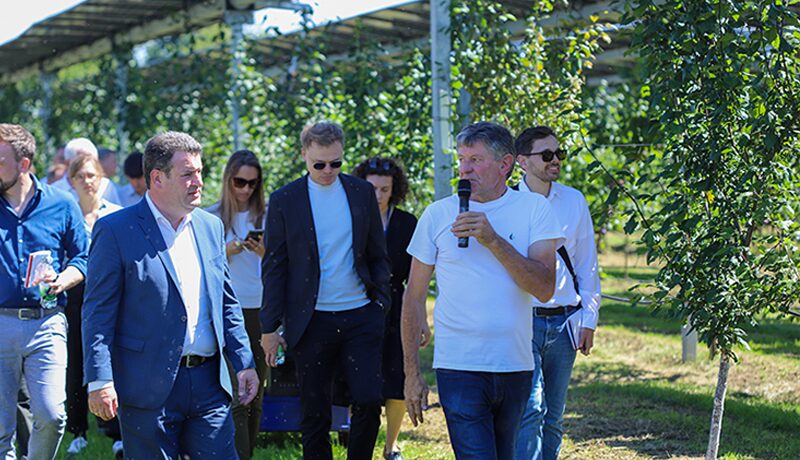
As part of his summer tour focused on AI in agriculture, Federal Minister Hubertus Heil visited our site yesterday — accompanied by more than 20 journalists.
We guided him through the facility, showcased our Agri-PV innovation, and even let him try his hand at harvesting blackberries under the PV system.

Innovation Meets Human Impact

The visit was a valuable exchange on the intersection of high-tech farming and sustainability, while also highlighting the people and purpose behind the technology.
We’re excited to see where this journey takes us and what positive ripple effects this visit might have sparked.

Agri-PV, Press Release

Press Release: Synergy Through Dual Land Use

12.04.2024

Germany’s Largest Agri-PV Orchard Installation Inaugurated

Oberkirch-Nußbach, June 2024 – As part of the research initiative “Model Region Agri-Photovoltaics for Baden-Württemberg,” a consortium of 13 partners led by the Fraunhofer Institute for Solar Energy Systems ISE is building and studying a range of Agri-PV pilot systems across the region. Early findings show that not only do crops benefit from partial shading, but PV modules also achieve higher yields thanks to evaporative cooling provided by the plants — a true synergy.

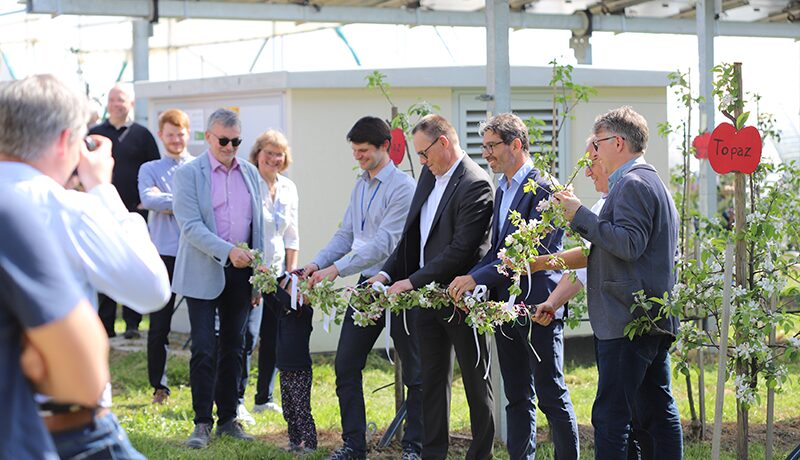
Today, Dr. Andre Baumann, State Secretary at the Ministry for the Environment, Climate and Energy, inaugurated the project’s fifth pilot system — located at Vollmer Fruit Farm in Oberkirch-Nußbach. The research focus at this site is on the interaction of orchard and berry crops with various PV tracking systems.

“Baden-Württemberg recently hit record numbers in solar expansion. But to make the energy transition a success, we must accelerate open-space PV as well. Land is limited, and Agri-PV gives us a double benefit — food and energy from the same area. That’s why this new Agri-PV orchard, now the largest in Germany, sends an important signal. The model region proves: agriculture and solar energy can work together, not against each other,” said Dr. Andre Baumann during the ceremony.

Less Water, Fewer Chemicals – More Power

At the first pilot site above apple trees in Kressbronn on Lake Constance, two years of measurements already show significant benefits:

  • 70% reduction in pesticide use

  • 50% less water needed for irrigation

  • 20% more solar power produced than expected

The additional power yield is believed to result from a combination of plant-induced cooling and improved airflow — a hypothesis now under further study.

“The PV modules benefit from the crops just as much as the crops benefit from the PV system — when Agri-PV is designed right,” summarized Oliver Hörnle, Project Lead at Fraunhofer ISE.

The Nußbach System: Germany’s Largest Agri-PV in Orchard Farming

The new installation consists of four system types, including:

  • Fixed modules over kiwi, pear, apple, and plum trees

  • A semi-transparent tunnel system for berries

  • A dual-mode solar tracker system — one half adjusted based on plant physiology, the other half based purely on solar optimization

The advanced tracking algorithms, developed by Fraunhofer ISE, will be tested on-site with hardware provided by project partner Intech Clean Energy, beginning mid-2024. Agricultural monitoring is led by the Agricultural Technology Center (LTZ) Augustenberg.

Project Scope and Outlook

The overarching goal is to explore viable models for dual land use in agriculture and energy production.
Nine pilot sites across Baden-Württemberg are being equipped with tailor-made Agri-PV systems, covering a range of fruit and berry crops and diverse installation types.

The project is funded by the State Ministries for Environment, Climate and Energy and for Food, Rural Areas and Consumer Protection, and will run through the end of 2024.